
Specialised tax advisory
Tax Advisory for Direct Investments in Renewable Energy
Photovoltaic & battery storage — well-founded tax and business advisory. For investors and project developers alike.
Steuber Ludwig Steuerberater Partnerschaft mbB · Cologne · Active throughout Germany
The investment process
How we accompany your investment — in just over two minutes
From the first look at the numbers to the annual tax return: independent, no sales, honest answers — explained step by step (German narration).
Illustrated scenes and narration are AI-generated — content and wording are ours.
Which side do we advise you on?
Which side do we advise you on?
For IAB investors / buyers
Planning to invest in photovoltaics or battery storage? We independently review the economics, the tax design of the contracts, and your individual tax and return situation — before you commit.
Services for investors
For project developers / providers
You structure PV or storage direct investments? We support you with tax and conceptual advice when designing market-ready offerings.
Services for developers
Services
Services for IAB investors / buyers
Before you invest, you should know what you are actually buying — fiscally, economically and in terms of return.
Our services in a 60-second video
Background visuals are AI-generated.
Sourcing suitable offerings
We support numerous clients across Germany in identifying soundly designed, return-worthy investments. Our broad market overview helps to filter out unsuitable, unprofitable offerings.
Economic viability analysis
Independent assessment of the investment offer: our own return calculation (IRR before and after taxes; optionally including potential tax optimisation over time), plausibility check of projected revenues and costs, realistic scenarios.
Tax structuring
Optimal and legally sound use of the investment deduction (IAB) and special depreciation. Avoidance of GbR (partnership) tax risks and inadvertent tax co-entrepreneurship with other investors.
Contract review
Tax and business review of contract documents: ownership allocation for the PV system (and any green-power storage) and the inverter, EEG/PPA/CPA contracts, storage usage rights, cost structure.
Market check
Market check of your investment versus other current offerings. Risk assessment to avoid revenue and liquidity shortfalls due to current and upcoming market situations — e.g. avoiding negative power prices, exploiting storage arbitrage, contextualising current regulatory changes.
Bookkeeping after investment
Ongoing tax advisory and setting up cost-efficient bookkeeping for your photovoltaic or storage investment (also as coaching for self-bookkeeping) — bookkeeping with VAT pre-registrations (monthly/quarterly), annual statements / income surplus accounting in the IAB / investment phase and operating phase, tax returns, audits.
Financing review
Business assessment of the financing structure: equity requirement, debt ratio, interest and repayment models, collateral. Review of impact on IRR (internal rate of return of your investment) and leverage effect.
Tax concept design
Designing viable direct investment structures for photovoltaics and battery storage — from tax-relevant system configuration to investor tax impact.
Tenability check
Independent review of the tax tenability and profitability of your offers: IAB applicability, depreciation base, liquidity effects from depreciation in planning/construction phase and after-sales phase (live phase from commissioning).
Contract documents
Optimisation of your contract documents from a tax and business perspective (civil-law review by attorneys from our partner network) — so investors get what you promise.
Investor communication
Support with tax-related arguments toward investors and their advisors — clear statements, defensible numbers. Focused on integrity and legal certainty.
Sales training
Training for your sales team on solid tax-related framing of your projects and on sustainable return promises before and after taxes — confident in investor conversations, without untenable claims.
Expert opinions: IAB eligibility & economics
Robust tax opinions on the IAB eligibility of specific projects or structured direct investments, plus opinions on economic-viability calculations — a sound basis for providers, investors and the tax authorities.
Rooftop PV tax exemption
Advice on the income-tax exemption under Section 3 no. 72 EStG for rooftop photovoltaic systems and on the appropriate tax structuring.
Zero VAT rate
Assessment of applicability and written statements for the zero VAT rate under Section 12 (3) no. 1 and 4 UStG.
Tax structuring for PV
Specialised advice on the design, construction and operation of PV systems — legally sound structuring.
Market situation 2024 / 2025
The market has changed significantly
In recent years, many offers have entered the market that target tax benefits exclusively and do not clearly disclose the projects' „real" returns — they are not viable on a pre-tax basis and only become attractive to investors through IAB and financing leverage effects. Negative power prices, changed EEG rules and shifting storage marketing make a thorough review more important than ever. Do not rely solely on the provider's tax narrative. Beyond purchase price, revenues and operating costs, review the entire concept for future viability.
What „IAB direct investments" can deliver
Benefits when properly structured
With sound tax and economic design, direct investments in PV and storage are attractive building blocks for wealth and retirement provision. Depending on risk profile they complement other conservative investments such as buy-to-let real estate, pension insurance / ETF savings plans. Particularly attractive in the case of severance payments and generally for exploiting tax-rate gradients (overall tax burden across the investment period is then lower than without IAB; an advantage over other investment types such as real estate).
30–35 %
Equity from tax refund
IAB and special depreciation can cover a large share of the required equity through the tax refund — ideally, ongoing equity demand stays low. Depending on your tax rate, 30–35 % of net acquisition cost can be financed entirely from the tax refund; the financing / own-funds share alongside is correspondingly small and leverages return on equity.
25–40 years
PV system lifetime
Photovoltaic systems deliver predictable revenue over decades when properly designed and revenue shortfalls are avoided — an opportunity for a long-term, asset-backed cash flow component.
10–20 years
Battery storage lifetime
Battery storage has a shorter lifetime, but currently strong revenue potential from arbitrage and balancing energy — if marketing is right.
What to look out for
Checklist — Before You Buy
These ten points are what we check on every investment offer — use them as a checklist for your own conversations with providers.
Review of taxable income over time and choice of the optimal assessment year for the IAB deduction and special depreciation (§ 7g (1), (5)+(6) EStG), choice of the right investment vehicle (tax subject), inclusion of personal / family situation (potentially anticipated succession over time) in tax-rate optimisation, plan for the future (tax-rate optimisation over the investment horizon). After-tax IRR simulation.
Review the financing structure economically — bank, subsidised loan, own funds, collateral — aligned with the system's cash flow and your personal situation. Account for short-term liquidity needs (VAT).
Optimal planning of tax liquidity from tax refunds via IAB and special depreciation for the investment. Make use of legally available applications to receive tax refunds before submitting the annual tax return — for example to reduce wage tax payments during the year.
Are the contracts cleanly and viably set up under civil law*, tax law and from a business perspective? Who becomes owner of the system, who holds which rights and earns which revenues or bears which costs?
* Contract advice outside the tax assessment must be provided by a suitable attorney (i.e. not by us). Most providers of direct investments already set up their contract documents with specialised law firms. We review these for you from a tax and business perspective.
Total system size, EEG, PPA or CPA contracts, guaranteed kWh yields, location quality, technical components.
Directly attributed inverter or shared infrastructure? Implications for tax ownership attribution (caution also with trustee constructs).
Clear ownership and usage rights to the storage unit, no hidden co-entrepreneurship risks, cleanly delineated revenues and a fair cost structure.
Where green-power storage is included in the electricity marketing (direct purchase or shared use, e.g. via infrastructure usage agreements): are the green-power batteries contractually and conceptually set up correctly, with clear ownership and usage arrangements (avoidance of GbR risks that could affect IAB eligibility)?
How is the use of infrastructure shared with other investors contractually regulated?
For battery storage direct investments, scrutinise critically whether an IAB-eligible asset is actually being purchased (rack solution with a shared inverter vs. a fully self-contained stand-alone storage unit including its own inverter).
→ This applies to stand-alone grey-power storage just as it does to green-power storage if the latter is acquired together with a PV system and no clearly regulated infrastructure usage agreement exists.
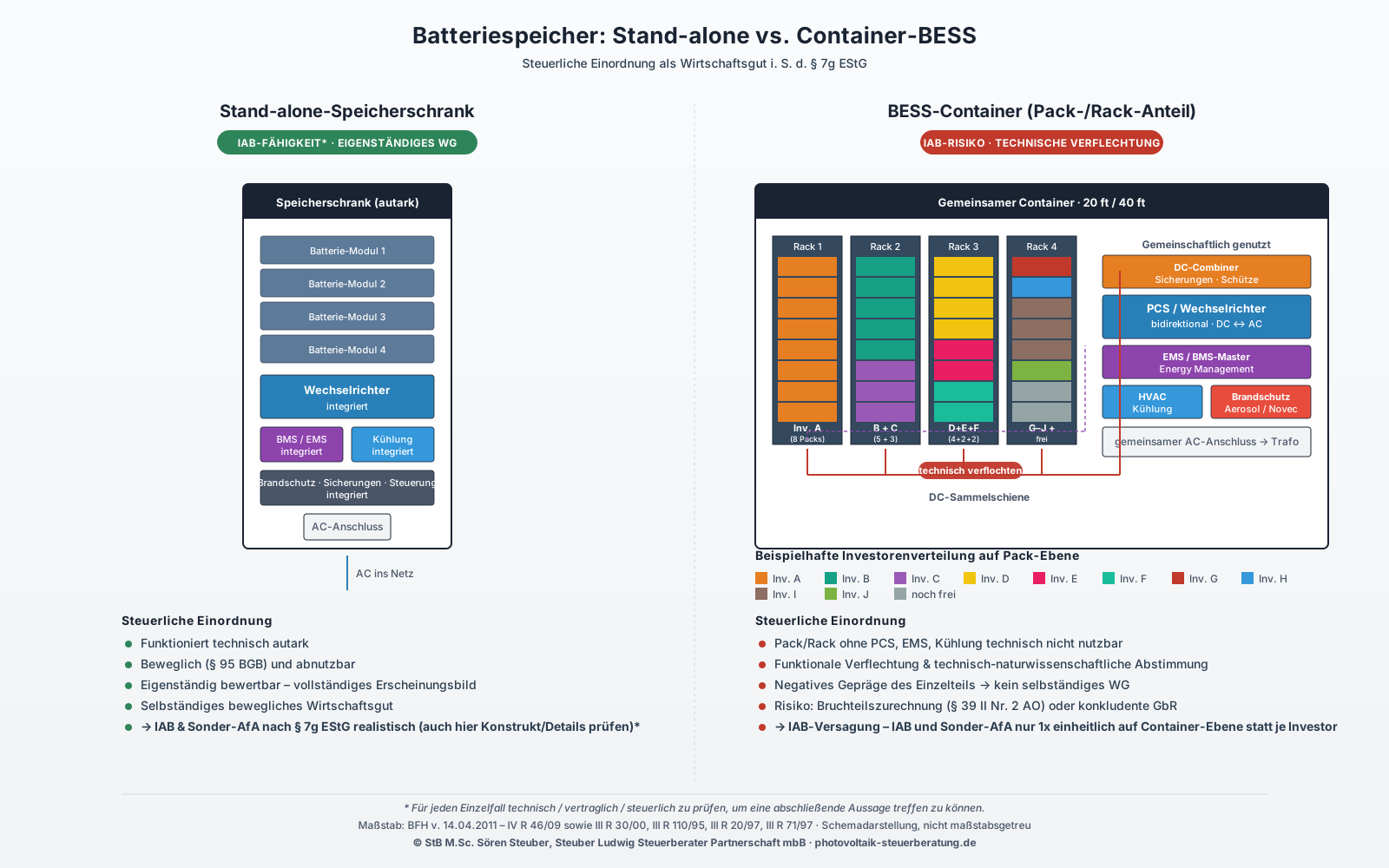
Stand-alone storage vs. container BESS — tax classification as an asset under § 7g EStG. Purchase price per kWp relative to projected annual yields. Operating costs, lease, insurance — fully and transparently agreed, return implications properly assessed?
EEG full feed-in, PPA / CPA, direct marketing, storage marketing, shared storage, profit-sharing arrangements — what fits your system and minimises tax risks? What ensures the most robust return over the investment horizon?
Yield forecasts, choice of marketer, regulatory risks, repowering costs over the lifetime.
How is the system accounted for? Which ongoing costs and tax obligations apply to you? Every direct PV investment follows the same compliance roadmap:
- Tax registration with the tax office – in the year of the IAB deduction, because for tax purposes the business starts with the first preparatory action
- Trade registration at your place of residence (principal establishment)
- VAT advance returns once your tax number is issued – initially usually nil returns
- Upon purchase: second trade registration in the municipality where the system is located, plus reclaiming input VAT from the purchase-price instalments
- Operating phase: electricity revenue settlement, VAT routine, lean bookkeeping software
- Annual filings: cash-basis profit calculation (EÜR) with asset register, income tax return (Anlage G), annual VAT return
Important for 2026
Use the investment deduction (IAB) for 2026
If you want to claim the IAB in your 2026 tax return, you should obtain concrete investment offers by year-end and document them properly. The actual investment can then take place between 2027 and 2029.
Note: An investment can of course also be made immediately without prior-year IAB deduction, using "only" the special depreciation and declining-balance depreciation. This must be assessed individually (see checklist item 1).
⏱ Deadline: obtain and document offers by 31 December 2026
Contact
Let's talk about your investment
Planning to invest in photovoltaics or battery storage and need an independent view? Or are you a project developer structuring direct investments and looking for an experienced tax advisor? Get in touch.
Or directly:
Contact: Sören Steuber, M.Sc. (German Certified Tax Adviser)
- Phone
- +49 (0) 221 95019567
- Please use the contact form